

Tampa Bay, Florida · Reachable only by boat
Egmont Key: Snorkeling the Submerged Civil War Ruins
An uninhabited island at the mouth of Tampa Bay with a lighthouse from 1848, free-roaming gopher tortoises, and brick gun batteries that have sunk into the shallows — which you can snorkel over, and jump from.
Egmont Key is an uninhabited barrier island and National Wildlife Refuge at the mouth of Tampa Bay, accessible only by boat. Its defining feature is a set of partially submerged Civil War–era battery ruins in shallow water off the island’s edge — brick walls, archways, and foundations now colonized by marine life, which guests snorkel around and jump from.
The island also has a working lighthouse dating to 1848, a population of free-roaming gopher tortoises, and protected sea turtle nesting beaches. Cownose rays migrate through the surrounding water, and live sand dollars turn up on the sand bottom out this way.
Wayward Key Tours runs private charters to Egmont Key from the Maximo Park boat ramp in St. Petersburg — roughly 45 to 60 minutes out. The 4-hour Half-Day Island Escape ($575 flat, up to 6 guests) is the charter to book; a 2.5-hour trip does not leave enough time once you account for the crossing.
Getting there
Boat only
no bridge, no road
From Maximo Park
45–60 min
depending on conditions
Lighthouse built
1848
still operating
Recommended charter
$575 · 4 hrs
up to 6 guests
What Egmont Key actually is
A small island with an outsized history, three miles west of Fort De Soto.
Egmont Key sits at the southern mouth of Tampa Bay, where the bay opens into the Gulf of Mexico. It is uninhabited, it is a National Wildlife Refuge and a state park, and it has been militarily significant for most of its recorded history.
A Union garrison occupied the island during the Civil War. It became a staging point during the Spanish-American War, when the gun batteries were built. Later it served as a Coast Guard station. What remains today is a set of brick fortifications, some still on land, and some that the Gulf has taken back — sitting in shallow water at the island’s edge as the shoreline shifted over the last century.
That is the part that makes Egmont unlike anywhere else on this coast. It is not a reef and it is not a wreck. It is a fort you can swim through.

Snorkeling the ruins
What it is actually like in the water, honestly described.
The submerged batteries create underwater structure you will not find at a typical Gulf snorkeling spot. Brick walls, archways, and foundations, all in relatively shallow water, with rays, fish, and the occasional sea turtle moving around them.
Guests who are comfortable in the water also jump from the ruins — which is what turns Egmont from a look-at-things stop into something people talk about afterward.
Setting expectations honestly: this is not Caribbean reef snorkeling, and we would rather say so than have you arrive expecting one. The Gulf here is sand bottom and visibility varies with the day and the tide.
What Egmont has that a reef does not is the structure itself and the strangeness of swimming through a military fort. On a good day the combination is genuinely remarkable. On a poor-visibility day it is still a fort, and the island above the water is worth the trip on its own.
We carry masks, snorkels, and fins in sizes from kids through adults, disinfected before every trip. If you own gear you love, bring it. More on our private snorkeling charters.
How rough it can get, and why that matters
The single most important practical thing to understand about Egmont Key.
Egmont sits exactly where Tampa Bay’s currents meet the Gulf’s. Conditions there can be completely different from the calm inshore water you experienced an hour earlier on the same charter. On the wrong day, wind, tide, and current combine and the water becomes choppy enough that snorkeling is neither comfortable nor sensible.
Captain Keith assesses conditions before committing to the run. If the water is not right, he will either shift the timing around the tide or take you somewhere else worth going. That judgment is not a nicety — it is the difference between a good day and a group of seasick people bobbing in murky chop.
This is where an experienced captain earns the fee. Captain Keith spent eleven years as a Navy submariner and worked as a Navy diver. Reading water, current, and conditions is not a skill he picked up running charters — it is what he did for a career before this one.
While guests are in the water at Egmont, he stays on watch. Currents move at the mouth of a bay, boats come through the channel, and six guests is about the number one person can genuinely keep track of.
The island above the waterline
A National Wildlife Refuge with almost no people on it.
The lighthouse
Built in 1848, replacing an earlier structure a hurricane destroyed, and one of the oldest standing lighthouses on Florida’s Gulf Coast. It still operates as an active aid to navigation and is visible from the water as you approach.
Gopher tortoises
The island’s interior has a thriving population of free-roaming gopher tortoises. Walking a sand path and meeting one is the moment most kids remember from the day. They are a threatened species and protected — look, do not touch.
Cownose rays
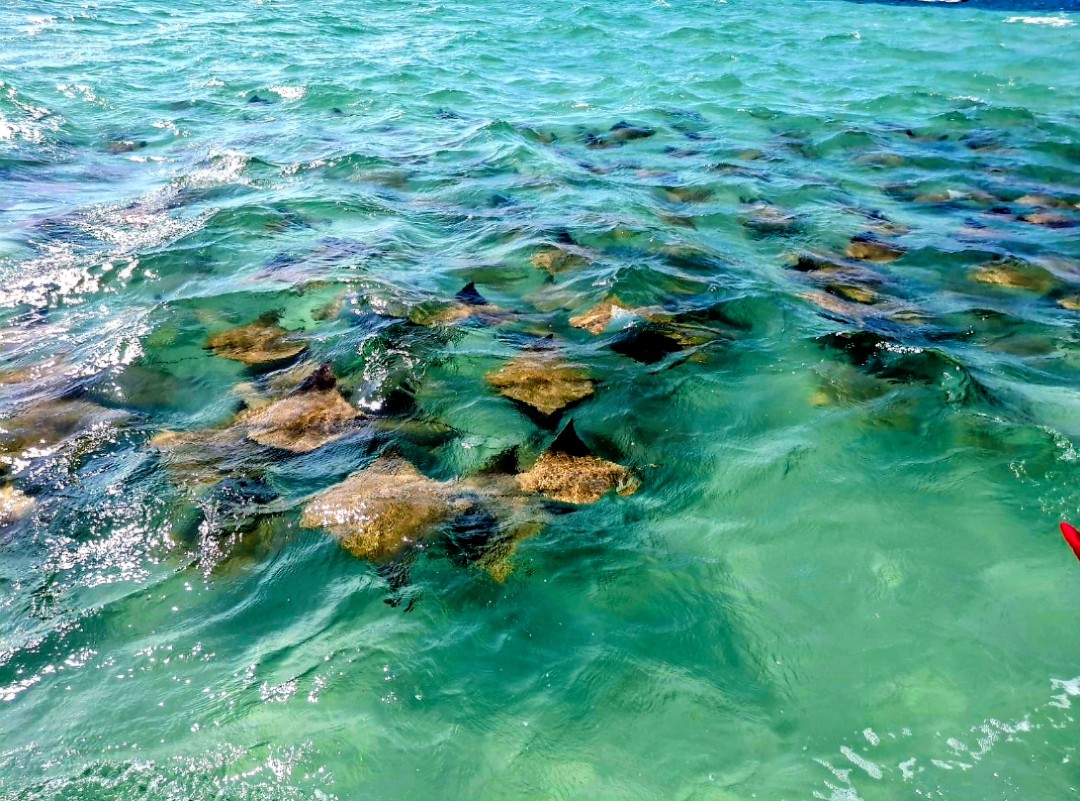
Cownose rays migrate through these waters, and when they come through it is not one or two — it is a moving formation of them, dark shapes travelling together just under the surface. Seeing it from the boat is one of those things guests do not expect and then talk about for the rest of the day. It is a migration, so it is not on a schedule anyone controls, but this is the stretch of water where it happens.
Sea turtles
Egmont is an active nesting beach. Loggerheads and green sea turtles nest here seasonally, roughly May through October, and are regularly spotted in the water around the island. Nesting areas are marked and off limits.
Shorebirds
Ospreys, brown pelicans, herons, and a range of shorebirds nest and feed around the island year-round. Because the refuge is largely undisturbed, wildlife here is abundant and noticeably less wary of people than on a public beach.

What is on the bottom is worth a look too. On one charter out this way the anchor started to drag, which is the sort of small thing Captain Keith notices before anyone else does. Looking over the side, the bottom was covered in little gray discs.
He put a mask on and went down about three feet to see what they were — five live sand dollars, sitting right by the anchor. Nobody would have known they were there from the deck.
That is fairly typical of how a day out here goes. The plan gets you to the island; the good parts tend to be whatever turns up on the way.

Getting there, and what to bring
There is no bridge, no road, and no reliable public ferry.
Wayward Key Tours departs for Egmont Key from the Maximo Park boat ramp in St. Petersburg — 45 to 60 minutes to the island depending on conditions. We do not run Egmont trips from Clearwater; the St. Petersburg departure puts you far closer to the mouth of the bay, and the extra crossing time from the north would eat the day.

Book the 4-hour Half-Day Island Escape ($575 flat, up to 6 guests). Between the crossing out, real time to snorkel and walk the island, and the run back, four hours is the minimum that makes the trip worth doing.
- Reef-safe sunscreen — the sun at the mouth of the bay is strong and there is essentially no shade on the island
- Water shoes — the island terrain and the ruins are uneven, and brick underwater is not forgiving
- A light layer — it is breezy out there even when it is still inshore
- Water and snacks — there are no facilities of any kind on the island. We provide a cooler, ice, and bottled water
- An underwater camera or GoPro — the ruins below the surface photograph better than you would expect
- Nothing you mind getting wet — you will be in and out of the water
There is a fuller list on our what to bring guide, and details on how a charter day runs in what to expect on your first charter.
Planning from overseas?
Egmont brings a lot of international visitors, and we are set up for it.
A fair number of the people who book Egmont with us are not from Florida — they found the island while researching a trip and realised you cannot simply drive to it. If that is you, a few practical notes.
Email is the easiest way to reach us across time zones. Write to contact@waywardkeytours.com and we will work around the difference — you do not need to place an international call. You can also book directly online at any hour.
Book earlier than you think. We run one boat and one group at a time, so a specific date on a specific week fills faster than a multi-boat operator would. If your trip dates are fixed, reserve as soon as you have them.
Build in flexibility if you can. Egmont is the one destination where weather genuinely can force a change. If your itinerary has a spare day, tell us when you book and we will treat it as a backup.
Common questions about Egmont Key
How do you get to Egmont Key?
Egmont Key is accessible only by boat. There is no road access and no bridge. Wayward Key Tours departs from the Maximo Park boat ramp in St. Petersburg, roughly 45 to 60 minutes to the island depending on conditions. Departing from St. Petersburg rather than Clearwater puts you significantly closer to the mouth of Tampa Bay.
Can you snorkel the Civil War ruins at Egmont Key?
Yes. The partially submerged brick batteries sit in relatively shallow water off the island's edge, and guests snorkel around the walls, archways, and foundations. Marine life has colonized the structures over the decades. Guests who are comfortable in the water also jump from the ruins.
How much does an Egmont Key charter cost?
The 4-hour Half-Day Island Escape is $575 flat for up to 6 guests, and it is the charter we recommend for Egmont Key. The travel time out plus meaningful time to snorkel, explore the ruins, and see the island needs the full four hours. A 2.5-hour charter does not leave enough time to make the trip worthwhile.
Is Egmont Key good for kids?
Yes, for children 5 and up, which is our minimum age. The gopher tortoises are usually the highlight for younger guests, and the shallow water around the ruins is manageable for confident swimmers. Captain Keith stays on watch the entire time guests are in the water. Bring water shoes; the terrain and ruins are uneven.
Can the water be too rough to visit Egmont Key?
Yes, and this is worth knowing before you book. Egmont Key sits where Tampa Bay meets the Gulf, and bay and Gulf currents converge there. On the wrong day wind, tide, and current combine to make the water choppy and uncomfortable for snorkeling. Captain Keith assesses conditions before heading out and will either adjust the timing around the tide or navigate to an alternative spot.
Is there a ferry to Egmont Key?
There has historically been seasonal ferry service to Egmont Key, but it does not run reliably or year-round, and it lands you on the island with a fixed schedule and a crowd. A private charter lets you time the visit around the tide, stay as long as the conditions are good, and snorkel the ruins with your group only.
What is the Egmont Key lighthouse?
The lighthouse was built in 1848 and is one of the oldest standing lighthouses on Florida's Gulf Coast. The current structure replaced an earlier one destroyed by a hurricane. It still operates as an active aid to navigation and is visible from the water on approach.
Are there restrooms or facilities on Egmont Key?
There are no concessions, no food, no drinking water, and no shade to speak of on the island. Bring everything you need. Our boat has an enclosed restroom, a freshwater rinse wand, a cooler with ice, and bottled water, so most guests treat the boat as their base.
Are we allowed to take things from the island?
No. Egmont Key is a National Wildlife Refuge and a state park. Shells, artifacts, and anything else stay where they are. Sea turtle nesting areas are marked and off limits during nesting season, and the ruins are historic structures — the island is protected for good reason.
What wildlife might we see around Egmont Key?
On the island: free-roaming gopher tortoises, ospreys, brown pelicans, herons, and other shorebirds. In the water: rays and fish around the submerged ruins, sea turtles seasonally, and cownose rays when they migrate through — which is a genuine spectacle when it happens. Live sand dollars turn up on the sand bottom in this area. None of it is guaranteed on any given day, because it is wildlife.
When is the best time of year to visit Egmont Key?
Spring and fall generally offer the calmest water and the most comfortable conditions at the mouth of the bay. Summer brings warm water and good visibility but afternoon storms are common. Sea turtle nesting season runs roughly May through October. Winter is quieter and can be beautiful, though cold fronts make the crossing rougher more often.
Other stops on the St. Pete side
Egmont pairs naturally with these on a four-hour charter.
Shell Key Preserve
A protected barrier island with some of the best shelling anywhere near St. Petersburg, and calmer water than the mouth of the bay.
Read the Shell Key guide →Fort De Soto by boat
Three miles east of Egmont. Arriving by water gets you the sandbars and the back side of the park, which is a different place than the one you drive to.
Read the Fort De Soto guide →Everything on the St. Pete side
The full picture of what there is to do on the water near St. Pete Beach, and how a St. Pete day differs from a Clearwater one.
See the St. Pete guide →Private island hopping
The charter that ties them together — several islands in one day, picked that morning based on tides and conditions.
See island hopping →Book a private Egmont Key charter
Departing from Maximo Park in St. Petersburg. Your group only, up to 6 guests, with Captain Keith at the helm and the day timed around the tide for the best water at the ruins.
Half-Day Island Escape
$575
4 hours · up to 6 · recommended for Egmont
Gulf Escape
$395
2.5 hours · too short for Egmont
Sunset Escape
$425
2.5 hours · champagne included